What an SOP Is (And Why You Need It in Writing)
A Standard Operating Procedure is a written, step-by-step set of rules that everyone follows — not what the trainer said once during orientation.
Why written SOPs matter:
- OSHA citations for 'inadequate training' usually cite the absence of written procedures
- In an accident investigation, a written SOP proves you trained the standard — or its absence proves you didn't
- New operators learn from the document, not from whoever trained them (and whatever they forgot)
- Insurance claims are decided on documentation. No SOP = you were negligent, in writing
This document is a template. Adapt it to your facility: your layout, your equipment, your rules. Then have every operator sign that they've read and understood it.
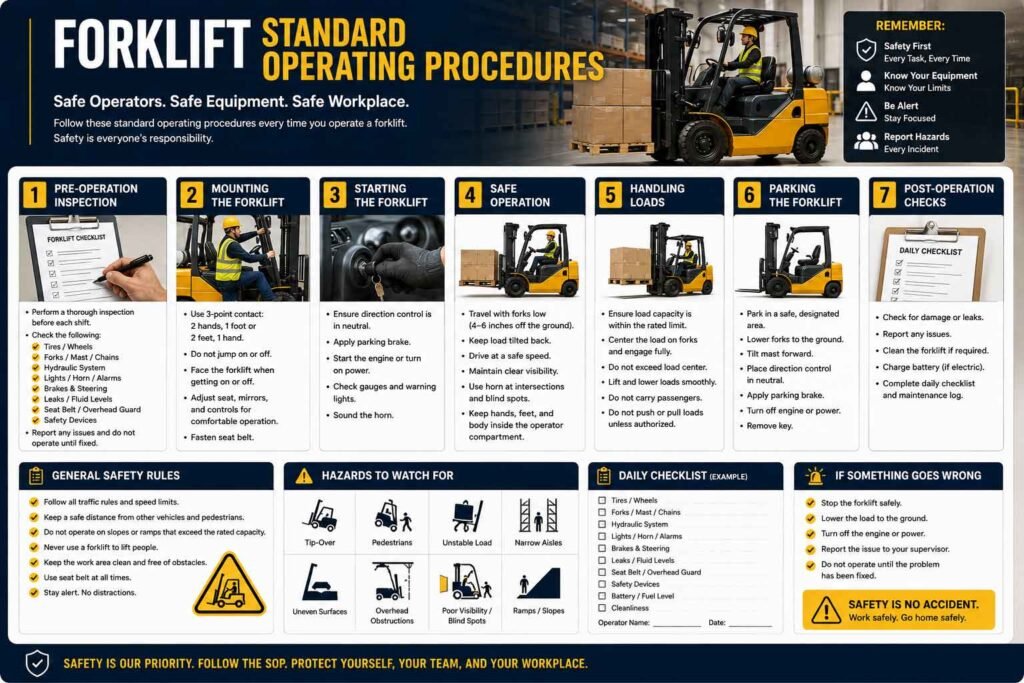
Forklift Standard Operating Procedures
Section 1 — Operator Qualifications
- Only trained, certified operators may operate a forklift. Certification requires a documented performance evaluation at least every 3 years. Refresher training is required sooner if triggered by an unsafe observation, an accident or near-miss, a switch to a different truck type, or a workplace condition change — see our OSHA Forklift Requirements guide for the full breakdown.
- Operators must be 18+ years old (US federal requirement).
- Operators must pass a vision test and have no medical condition affecting safe operation.
- Operators must be physically able to operate the controls and see the load.
- Anyone who has had an accident, near-miss, or observed violation must be retrained before operating again.
- Certification cards must be carried or available at the workstation.
Section 2 — Pre-Start Inspection (Before EVERY Shift)
Complete the inspection checklist before the first operation of each shift. Tag the truck 'Out of Service' if any defect is found. Do not operate a defective truck.
Step-by-step:
- Visual walk-around: check tires, forks, mast, chains, hydraulic hoses for visible damage or leaks
- Check data plate is present and legible
- Check fluid levels (electric: battery; diesel/LPG: oil, coolant, fuel, hydraulic fluid)
- Check battery charge level and connections (electric)
- Enter the cab, fasten the seat belt
- Test horn, backup alarm, lights, and strobe
- Test brakes (service and parking)
- Test steering (full lock both directions)
- Test mast: raise, lower, tilt forward/back — listen for unusual noise
- Test fork movement: raise forks 100 mm, check stability
- Report any defect immediately. Tag and quarantine the truck.
The rule: If it takes less than 10 minutes, you're not checking. If it takes more than 15, you're inspecting — good.
Section 3 — Basic Operation Rules
- Seat belt on at all times — before moving, and no exceptions for 'short trips.'
- Forks at 100–150 mm above ground when traveling. Never travel with the load elevated.
- Speed limit — posted limit (typically 8–10 km/h indoors). Reduce speed at corners, doorways, and near pedestrians.
- Sound the horn at blind corners, doorways, intersections, and when reversing.
- Look in the direction of travel. If the load blocks forward vision, travel in reverse.
- Pedestrians always have the right of way. Stop for pedestrians. Do not drive within 1 m of them.
- No riders. Never carry passengers on the forklift, forks, or mast.
- Keep all body parts inside the truck — arms, legs, head.
- No cell phones, no headphones, no distractions while operating.
- No horseplay, racing, or 'training' friends.
- Do not push or drag anything with the forklift — pallets, trailers, or equipment.
- Never lift people on the forks — use a certified personnel platform or man-up equipment.
- Never walk under elevated forks or loads — operators and pedestrians.
- Never exceed the rated capacity shown on the data plate.
- Loads must be centered on the forks and against the carriage backrest.
Section 4 — Loading and Unloading Procedure
Picking up a load:
- Approach the pallet at right angles, forks level and at the correct height
- Insert forks fully into the pallet — at least 2/3 of the fork length
- Lift the load 100–150 mm, tilt the mast back slightly
- Verify the load is stable and centered before moving
- Check clearance behind you and sound the horn before reversing
Placing a load:
- Approach the rack/drop-off point at right angles
- Stop with the load in position — forks level
- Raise/lower to the correct height
- Move forward until the pallet is fully placed
- Lower forks, tilt forward slightly, and back out slowly
- Check both sides for clearance before moving away
The rules:
- Never lift a load that isn't fully on the forks
- Never carry a load with the mast tilted forward
- Never use the tilt function to 'scoop' or nudge loads
- If the load is unstable, lower it and re-position — do not travel
Section 5 — Travel Rules
- Drive with the forks lowered (100–150 mm clearance) at all times while traveling.
- On ramps:
- Travel with the load facing UP the ramp (load uphill)
- Travel empty with the forks facing DOWN the ramp
- Never turn or park on a ramp
- Rough or uneven surfaces: reduce speed, keep the load low, avoid sudden turns.
- Railroad tracks, thresholds, dock plates: cross at an angle and slowly.
- Dock loading:
- Check the dock plate is rated and secured before driving over it
- Check the trailer is chocked and the brakes are set
- Check the trailer has not separated from the dock before entering
- Verify trailer floor can support the truck and load
- Never drive off the edge of an unsecured dock
- Intersections and blind spots: stop, sound horn, proceed only when clear.
Section 6 — Parking Procedure
- Find a designated parking area — never block aisles, doorways, fire lanes, or exits.
- Lower the forks fully to the floor.
- Tilt the mast forward slightly (so the forks lie flat).
- Engage the parking brake.
- Turn off the ignition / power. Remove the key.
- Park on level ground whenever possible.
- In cold storage, follow the facility's parking/charging protocol.
The rule: A parked forklift with raised forks is a hazard and a liability. Forks down, brake on, key out.
Section 7 — Refueling and Charging Procedure
Electric (lead-acid):
- Park in the designated charging area — ventilated, no smoking
- Turn off the forklift before connecting the charger
- Wear eye protection when checking water levels
- Use distilled water only — never fill above the indicator
- Charge per the battery manufacturer's schedule
- Never charge a damaged or leaking battery
Electric (lithium):
- Use only the charger specified for the battery and truck
- Follow the BMS instructions on the display
- Opportunity charging is allowed — no full discharge needed
- Report any battery heating, swelling, or error codes immediately
Diesel / LPG:
- Shut off the engine before refueling
- No smoking within 10 m of fuel or LPG storage
- LPG: check tank, hoses, and connections for leaks before connecting
- Secure the LPG tank properly — never operate with an unsecured tank
- Clean up spills immediately — fuel spills are fire hazards and slip hazards
Section 8 — Emergency Procedures
Forklift tip-over:
- Do NOT jump out — you'll land under the overhead guard
- Hold the steering wheel firmly
- Brace your feet
- Lean away from the direction of the fall
- Stay in the seat until the truck stops moving
Load drop or spill:
- Stop immediately
- Sound the horn to warn nearby personnel
- Do not attempt to re-lift a fallen load alone — assess and call for help
- Barricade the area if the spill creates a hazard
Fire:
- Stop the forklift, turn it off, set the parking brake
- Evacuate the area — do not attempt to fight a fire in a charging area
- Use the correct extinguisher (Class C for electrical, Class B for fuel)
- Call emergency services and follow facility fire procedures
Accident with injury:
- Stop all operations — secure the area
- Do not move the injured person unless they're in immediate danger
- Call emergency services immediately
- Preserve the scene — do not move the forklift or loads
- Report the accident per facility policy — document everything with photos
Near-miss:
- Report every near-miss — no matter how minor
- Complete the near-miss report form
- Supervisors review near-misses within 48 hours
Section 9 — Daily, Weekly, Monthly Checks
| Frequency | What to Check | Who |
|---|---|---|
| Every shift | Pre-start inspection (Section 2) | Operator |
| Weekly | Tire pressure/wear, battery terminals, hydraulic hoses, mast rollers, grease points | Operator or mechanic |
| Monthly | Battery load test, hydraulic filter, wear pads, fork wear gauge, wiring harness | Mechanic |
| Every 500 hours | Oil/filter change (IC), hydraulic fluid top-up, full inspection | Mechanic |
| Annually | Full service + certification inspection | Certified technician |
Section 10 — Operator Acknowledgment
Every operator must sign:
'I have read and understood the Standard Operating Procedures for forklift operation at [Facility Name]. I understand that failure to follow these procedures may result in disciplinary action, including removal from forklift operation. I will complete the pre-start inspection before every shift and report all defects, accidents, and near-misses.'
| Name | Signature | Date | Certification # |
|---|---|---|---|
The Bottom Line
A forklift SOP isn't paperwork for its own sake. It's the difference between 'we told them to be careful' and 'we trained them to a documented standard.' In an audit, an accident investigation, or an insurance claim, the written document is the only thing that counts.
Adapt this template to your facility. Get every operator to sign it. Post it in the break room. Enforce it — the operator who skips the pre-start check today is the operator in the accident report next month.