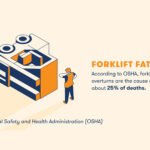
Forklifts are among the more dangerous pieces of equipment in industrial workplaces. In recent years, BLS counts have put forklift-related deaths in the US at roughly 60 to 90 workers per year, and OSHA's long-cited estimate is around 35,000 serious injuries annually. Most of these accidents trace back to a short list of repeated behaviors: skipped checks, speed, elevated loads, overloading, and poor pedestrian control. An OSHA study found that about a quarter of forklift accidents were due to inadequate operator training, and OSHA has reported that proper training could prevent up to roughly 70% of forklift accidents.
Below are 20 rules, the accident each one prevents, and what breaking it can cost. For the underlying numbers and their sources, see our forklift accident statistics guide. For a printable, signable version of these rules, see our forklift SOP template.
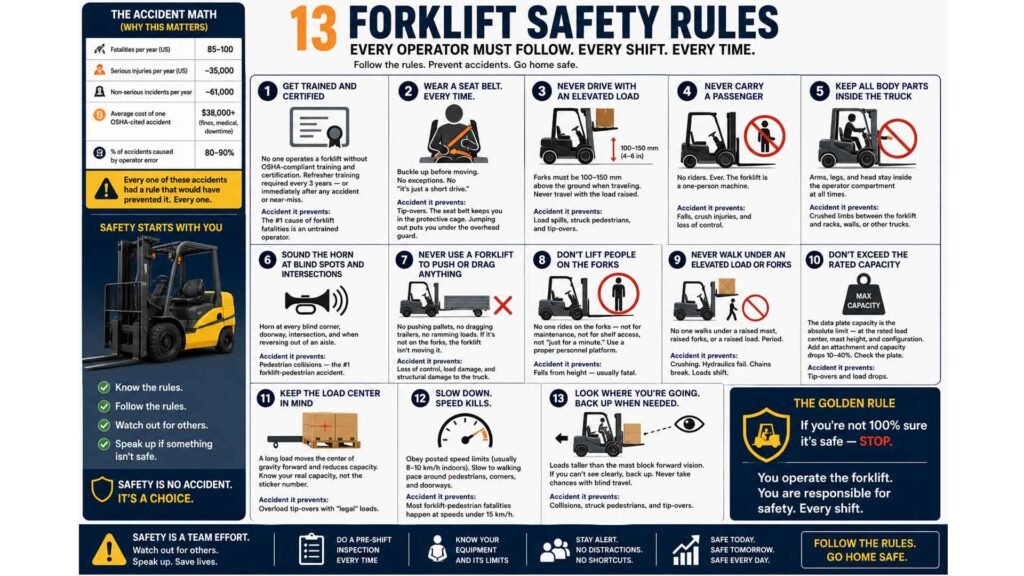
Forklift Safety Rules
Rule 1: Get Trained and Certified Before You Touch a Forklift
The rule: No one operates a forklift without completing OSHA-compliant training (or your country's equivalent) and being certified by the employer. Each operator's performance must be evaluated at least every three years, and refresher training is required whenever a trigger occurs: an unsafe operation observed, an accident or near-miss, assignment to a different type of truck, or a change in workplace conditions. See our OSHA forklift requirements guide for the full breakdown.
The accident it prevents: Incidents caused by operators who don't know the truck's limits. The first weeks on the job are among the riskiest.
The cost of breaking it: As of January 2026, OSHA penalties run up to $16,550 per serious violation and up to $165,514 per willful or repeated violation, and each untrained operator can be cited separately. Liability when an untrained operator hurts someone is a separate exposure.
Rule 2: Wear a Seat Belt. Every Time.
The rule: On trucks equipped with an operator seat and restraint, buckle up before moving. No exceptions for 'short trips.'
The accident it prevents: Fatal tip-over crush injuries. When a truck tips, the instinct is to jump, which puts you where the overhead guard is likely to land. The trained response: hold the steering wheel firmly, brace your feet, lean away from the direction of the fall, and stay in the seat until the truck stops.
Note: this guidance applies to sit-down counterbalance trucks with seat belts. For stand-up trucks, reach trucks, and order pickers, follow the manufacturer's instructions and your site's training for tip-over response.
Rule 3: Never Drive With an Elevated Load
The rule: Travel with the forks about 100–150 mm (4–6 inches) off the ground. Raise the load only when you are placing it.
The accident it prevents: Load spills, struck pedestrians, and tip-overs on turns. An elevated load raises the combined center of gravity, which is how trucks flip at speed.
Rule 4: Never Carry a Passenger
The rule: No riders. A forklift is a one-person machine.
The accident it prevents: Falls, crush injuries, and loss of control. A passenger has no handholds, no restraint, and no protection.
Rule 5: Keep All Body Parts Inside the Truck
The rule: Arms, legs, and head stay inside the operator compartment at all times.
The accident it prevents: Crushed limbs between the truck and racks, walls, or other equipment. Reaching out to grab a falling load is a common way to lose a hand or arm.
Rule 6: Sound the Horn at Blind Spots and Intersections
The rule: Use the horn at blind corners, doorways, intersections, and when reversing out of an aisle.
The accident it prevents: Pedestrian collisions. A pedestrian often can't see you around a rack, and the horn is the only warning they get.
Rule 7: Never Use a Forklift to Push or Drag Anything
The rule: No pushing pallets, dragging trailers, or ramming loads. If it isn't on the forks, the forklift isn't moving it.
The accident it prevents: Loss of control and structural damage. Forklifts aren't built to push, and shoving with the mast can bend it or twist the frame.
Rule 8: Don't Lift People on the Forks
The rule: No one rides on the forks, even briefly. Use a certified personnel platform designed for lifting people.
The accident it prevents: Falls from height, which are frequently fatal. Forks can shift and masts can drop.
Rule 9: Never Walk Under an Elevated Load or Forks
The rule: No one walks under a raised mast, forks, or load, operators and pedestrians alike.
The accident it prevents: Crushing. Hydraulics can fail, chains can break, and loads can shift without warning.
Rule 10: Don't Exceed the Rated Capacity
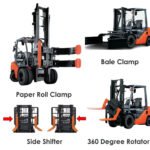
The rule: The data plate capacity is the limit, at the rated load center, mast height, and configuration. Attachments such as side shifters and clamps reduce effective capacity, roughly 10–40% depending on the attachment, and the truck should carry an updated plate showing the de-rated figure. See our guides on clamp attachments and boom attachments.
The accident it prevents: Tip-overs and load drops, which can happen with little warning once the limit is crossed.
Rule 11: Keep the Load Center in Mind
The rule: Rated capacity assumes a specific load center, commonly 600 mm (24 inches), which corresponds to a load about 1,200 mm long. A longer or bulkier load pushes the center of gravity forward and reduces safe capacity, by an amount that depends on your truck. Read the load capacity chart on your truck, not a rule of thumb. See our guide to load center.
The accident it prevents: Overload tip-overs with loads that look 'legal' by weight alone.
Rule 12: Slow Down
The rule: Obey posted speed limits. OSHA doesn't set a single speed limit for forklifts, but a maximum of about 5 mph (8 km/h) is widely used on site, and less around pedestrians, corners, and doorways.
The accident it prevents: Collisions and tip-overs. A truck moving at walking-plus speed with a load is still several tons of steel, which is more than enough to seriously injure a pedestrian.
Rule 13: Look Where You're Going. Back Up When Needed
The rule: If the load blocks forward visibility, drive in reverse with the horn sounding.
The accident it prevents: Pedestrian strikes and rack collisions caused by driving blind.
Rule 14: Never Operate With a Defect
The rule: Report any defect immediately, including brakes, horn, lights, hydraulics, chains, tires, and operator-protection features. Tag the truck out of service and don't use it until it's fixed. See our maintenance checklist for what to check each shift.
The accident it prevents: Mechanical failures that a pre-shift check would have caught.
Rule 15: No Horseplay. No Distractions
The rule: No racing, no 'teaching' a friend, no phones, no headphones. Hands and eyes on the job.
The accident it prevents: Collisions and loss of control from divided attention.
Rule 16: Refuel and Recharge Safely
The rule:
- Diesel/LPG: shut off the engine before refueling, no smoking or ignition sources nearby, and check LPG tanks and connections for leaks
- Lead-acid: charge in a ventilated area, with no smoking or open flames (charging produces hydrogen), and wear eye protection when checking water levels
- Lithium-ion: use only the manufacturer-specified charger and follow the battery management system's instructions
The accident it prevents: Fires and explosions from fuel vapor, hydrogen buildup, or incompatible charging equipment.
Rule 17: Pedestrians Have the Right of Way
The rule: The forklift yields to pedestrians every time, even if the pedestrian is in the wrong place.
The accident it prevents: Pedestrian injuries and deaths. A multi-ton truck gives way to a person on foot. This is not negotiable.
Rule 18: Watch the Overhead and Know Your Clearances
The rule: Know the height of your mast and load, and the height of every doorway, sprinkler line, pipe, and beam on your route.
The accident it prevents: Mast-versus-beam collisions that can topple the truck, damage building systems, or bring down overhead equipment. A sprinkler line hit by a raised mast can cause significant water damage on top of the repair.
Rule 19: Park Properly
The rule: Forks flat on the floor, parking brake on, key removed (or truck disabled), on level ground, in a designated area. Never park in an aisle, doorway, or fire lane.
The accident it prevents: Rollaways, trip and crush hazards from raised forks, and unauthorized use of a truck left running.
Rule 20: Report Near-Misses
The rule: Report and review every close call, even when nobody was hurt and nothing broke.
The accident it prevents: The next accident. A near-miss is free information about a hazard in your facility, and sites that log near-misses and act on them give themselves a chance to fix problems before someone is injured.
Two Myths Worth Dropping
Myth 1: 'Forklift accidents only happen to bad operators.' Experience doesn't make anyone immune. Routine breeds complacency, and complacency is a common thread in incident reports.
Myth 2: 'It's the operator's fault, not the company's.' Under OSHA's powered industrial truck standard, the employer is responsible for training, evaluation, equipment condition, and enforcing the rules. If a company tolerates rule-breaking, it carries that responsibility.
The Bottom Line
None of these rules is complicated, and none of them costs money to follow. What they cost is attention, every shift, from operators and from the supervisors who enforce them. Training, daily inspection, and consistent enforcement are the cheapest protection a forklift operation has.
For the legal side of training and recordkeeping, see our OSHA forklift requirements guide. To put these rules into a form operators can sign, use our forklift SOP template.
Where Maoxiang Fits
Safe operation starts with a trained operator, but the truck matters too. Our CE-certified forklifts are specified with operator-protection features, braking systems, and alarms suited to the working environment, and we'll tell you exactly what's standard versus optional on the model you're quoting. Tell us about your site, aisle layout, and pedestrian traffic and we'll recommend a configuration, including visibility aids and speed-control options.
(Confirm which of operator presence sensing, FOPS-rated overhead guards, electromagnetic braking, and backup alarms are standard on each model before publishing, and list them specifically.)